Recipes

Monday, November 14, 2011

The other side of the world

Nothing lends itself to artful depictions more than a vineyard. Rolling hills, gentle green canopies, plump grapes – magnificent. I love pictures of vineyards and their surrounding environments. In Eastern Washington, we live in the midst of some breathtaking vistas.

But getting out of your comfort zone every once in awhile can lead to whole new outlooks. So I went to Africa. My husband, his brother and our sister-in-law just finished an up-and-down, all-around trip to South Africa and Mozambique. We were visiting a few of our kids – my daughter and nephew – who are adventurous souls, devoting a good chunk of their youth to working with other cultures in a far corner of the world. The Peace Corps brought them both to Africa. Cathy lives in a Zulu village, working with the women and youth there.

 Marty is in Mozambique, leading a massive effort to replant Mount Gorongosa, a wildy rich and diverse ecosystem that has been stripped by poachers and loggers. They have big jobs with huge challenges, and enough optimism and energy to accomplish great things.

And they brought us to South Africa. This is a big country, encompassing vast deserts, towering mountains and a long and beautiful coastline fingering through two different oceans. The Atlantic and the Indian Oceans flow into each other at the Cape of Good Hope, producing cooling breezes that bathe the vineyards and olive orchards spilling down the granite and sandstone slopes at the base of the mountains.

This is one gorgeous piece of the world.


With some gorgeous vineyards


And some gorgeous wines. Here’s the thing about touring a new wine region – I never feel as if I found the best of the best. We had only one day in the Stellenbosch and Paarl regions, and we stopped at only four or five wineries. We had some great wines, some so-so bottles, and at least one that was downright bad.

But we tasted enough intriguing wines in the midst of some of the world’s most beautiful vineyards to make it a memorable day. Our tour included the largest corporate-style wine cooperative in the country,


along with several privately owned, albeit commercially oriented, wineries.


What we missed were the small producers, the hands-on artisan winemakers, the likes of which make up the vast majority of Washington’s 700-plus wineries. South Africa’s industry is centuries older than the New World’s, so the mom-n-pop wineries aren’t so prevalent, but there are certain truths that persist no matter where you make your wine. Number one – you need a great product. And Number two, a marketing twist doesn’t hurt.

Take Fairview. This farm, in the Paarl region, has a long and colorful history dating to the late 17th century. The first wines were made on the farm in 1699. Today, it produces a full menu of varieties including Sauvignon Blanc, Chenin Blanc, Riesling and Viognier, along with big reds like Mourvedre, Pinotage, Cabernet Sauvignon, Merlot and their signature Shiraz. The farm is also one of South Africa’s largest producers of artisanal goat cheeses, all produced from Fairview’s herd of Saanen dairy goats. The tasting fee allows you to taste six different wines, pairing them with a wide array of cheeses. (Notable – White Rock with Apricots, a white-veined blue cheese infused with the sweet fruit. Delicious.)

But the best way to sell wine, to my mind, is to let your customers get a little dirty. We signed on for Waterford Estate’s wine safari, beginning with a tour of the winemaking facility and barrel room, and a taste of the estate’s sparkling wine.


Then we jumped into a Land Rover for a spin through rocky, arid vineyards surrounded by olive trees and craggy sandstone cliffs. Waterford is located in the Blau Klippen Valley. The name means blue stones, and the vineyard’s red clay is speckled with namesake pebbles. 


We stopped near a pond at the base of the Olives Vineyard to kick around the rocks while tasting a delicious Blanc de Noir, blended from Sangiovese, Mourvedre, Grenache and Barbera. Next up was a 2009 Sauvignon Blanc, followed by a toasty, cinnamony Chardonnay that had been aged six months in French oak.
Back in the Land Rover, we moved across the farm to a higher elevation planted to red varieties. Kevin Arnold, Waterford’s winemaker and part owner, crafts smoothly nuanced, velvety reds, big with flavors of spice and plum (2008 Kevin Arnold Shiraz), vanilla-tinged red fruits (2008 Cabernet Sauvignon), and rich tobacco (2007 The Jem, Waterford’s signature blend of 60% Cabernet Sauvignon, 15% Shiraz, 5% Mourvedre, 7.5% Malbec and Cabernet Franc, and 2.5% Barbera and Sangiovese).


This was our last stop of the day, and by this time we’d not only pushed our driver deep into overtime, but had begun to focus more on conversation with our wine guides, and the stunning scenery, than on the wines themselves. That’s ok. I’m not a wine critic, just a happy traveler enjoying new views, and I believe that your first spin through a new wine territory should encompass all it has to offer – scenery, people, foods, as well as the wines. I have no way of knowing if the wines we tasted represent the best of Stellenbosch and Paarl, but I'm pretty sure they don't.  I do know that we enjoyed them.  South African wines are worth exploring again. I’ll be looking for them here at home, where I can consider them in a neutral setting. But I’ll be picturing their point of origin at the Cape of Good Hope.

Wednesday, September 7, 2011

Verjus!

I have a French friend who loves to point out English words that are actually French. Giraffe, par exemple. Garage. Restaurant. Weekend. Oh, wait! That’s an English phrase, but it means the same thing in French. Mon erreur.

And of course, veraison. In English, it rhymes with raisin. In French it rhymes with something else, but I’m not sure how to pronounce it. Segolene has been trying to teach me French for about six years now, but it doesn’t seem to be sticking. C’est la vie.

Sorry. I’m kind of beating this to death, aren’t I?

But back to veraison. It’s the point in a grape vine’s growing season when the little green berries stop growing bigger and the vine throws all its energy into ripening the grapes instead.


Acids transform into sugars.


Color deepens.


Flavor abounds.

It also marks the time when vintners thin their grapes. This is one of the fascinating things about growing wine grapes.  Unlike any other crop in the known world, quantity is not necessarily a good thing. At veraison, grape growers walk up and down the rows of their vineyards plucking off clusters of grapes and throwing them on the ground. Seriously. Can you imagine an Iowa corn farmer tossing half the crop in the dirt? Or an orchardist inviting birds in for an early snack on the cherries, just so we won’t have quite so many on the tree?

Wine growers do it all the time. Growing the perfect wine grape is a careful dance between the sun, the water and the soil’s nutrients. Too much of one can throw the balance way out of proportion. A grape vine can only produce so much nutrition. The idea is to find the sweet spot where the grapes deepen their flavors and sugars to an exquisite intensity. Too many grapes on the vine results in thin and boring flavors, so growers thin the crop just when the vine transitions from growing the grapes to ripening them. It’s been going on for centuries. In fact, they still celebrate veraison at Chateneuf du Pape with a wild and crazy medieval festival. Check it out:


Did you watch until the end? Did you see the crazy jester? Are you glad you did?

But back to veraison. Despite the practice of thinning the vines, growers make their living on how many grapes they sell. Throwing tons of them on the ground just has to hurt. Fortunately, there’s a remedy – verjus!

(Bless me. Thank you.)

But verjus (pronounced vair-zhoo) is nothing to sneeze at. (Sorry. Sometimes the puns just spill out all by themselves.) It’s the juice of those unripened grapes, and it makes a wonderful alternative to anything acidic you might use in sauces or dressings – vinegar, lemon juice, even wine.


Verjus has been produced in the Old World for centuries. Here in the New World, it’s not quite so well established.  David and Patricia Gelles, owners of the famed Klipsun Vineyard on Red Mountain here in Washington, discovered it years ago while on a tour of Australia when they met chef  and cookbook author Maggie Beer, who made prolific use of verjus. They have seen many seasons of varaison-thinned grapes rotting on the ground, and David was intrigued by the possibility of making something worthwhile of them.

Today Klipsun Verjus is marketed at select retailers and wineries across the Northwest, but you can order it directly from Alexander the Grape, a venture between David Gelles and his son Alexander, with the stated goal of “conquering the world of grapes.” (Puns abound, and it’s not all my fault.) It sells for $20 a bottle, which makes it a somewhat pricey alternative to specialty vinegars, but it is definitely worth adding to your kitchen arsenal. Because it originates as a wine grape, the acids complement rather than clash with wines served with food. Alexander’s web site abounds with recipes (stewed fruits, cheese cake, risotto) where verjus fills in as an alternative to lemon juice or vinegar.


But you don’t have to get too complicated to experience this lovely liquid. Try sautéing a pan of chicken breasts in butter and olive oil, then deglazing with verjus, finished with a little sage or thyme and a healthy portion of capers. Marinate chicken breasts in olive oil, verjus and rosemary, then grill. Splash a little directly onto a salad of spring greens, sliced strawberries and candied walnuts. Mix it up with a little mayonnaise, basil, oregano, thyme and garlic for a delicious aioli, perfect as a sandwich spread or a dip for fresh vegetables. Try it anyway you can think of. 

Enjoy your verjus.

Bless you.

Thursday, August 18, 2011

Daily Chocolate


Sunshine.  Cool blue water.  Pretty polish. A good read. No shoes.
Why.....yes, that is special! 


Saturday, August 13, 2011


Growing good things

One of the joys of living in Eastern Washington is the near-constant opportunity to bring great wines together with fresh foods grown practically right outside your back door. Figuratively speaking, of course. You might recall my feeble attempt at gardening.  If not, here's an update:


This is the PUH-thetic tomato plant I “nurtured” this summer. All appearances aside, it is not a victim of abuse. I have been very faithful about watering it, but it began to wither, branch by branch, almost as soon as it bloomed. Must be some kind of fungus or some such thing. 


But, just as the tag on the plant promised, it did indeed yield fruit in 60 days. Three smallish but lovely tomatoes. (The large one in the background is store-bought. Well, farmer’s market-bought.)

Fortunately, I am surrounded by people who know how to do it right. I live in the most bountiful corner of the great state of Washington, so I will never starve for a lack of fresh, homegrown veggies. I can simply step out my backdoor, climb in my car and head for a nearby winery that is likely to be hosting a winemaker’s dinner. That’s what we did a few weeks ago when we sat down for dinner at Mercer Estates.

(Actually, it’s not quite that easy. There are plenty of winemakers around here vying to serve you dinner, but not every night. Plus, you have to make reservations, and sometimes you have to belong to their wine club. Plan ahead. I’m just sayin’.)

Mercer Estates is owned by two venerable farming families, the Mercers and the Hogues. Our barbecue feast at Mercer was deeelicious. We started with assorted cheeses, and a tour of the winemaking facility and barrel room, led by Mike Hogue. Mike is a veritable treasure chest of wine knowledge. He is a member of the family that founded Hogue Cellars, one of Washington State’s oldest and largest producers. The Hogues sold the operation in 2001, while continuing to grow wine grapes. They also produce a large and lovely crop of apples. The Mercer family has grown a wide variety of vegetables in the Yakima Valley for more than 100 years. They planted their first wine grapes in 1972. When the two clans joined forces, happy things occurred.


Mike is showing us on the map here the locations of the vineyards that produce the grapes for Mercer Estates wines. Many of them come from the Horse Heaven Hills, location of the famed Champoux Vineyard, which was originally owned by the Mercers. The Horse Heavens are also the site of Mercer Estate’s Spice Cabinet Vineyard, which gave birth to the Mourvedre we drank at dinner, a tasty barbecued steak served with signature Hogue and Mercer family dishes. The Mercer carrot salad was tangy with lime juice, cilantro and coriander, and the Hogue apple pie was just as delicious as you would expect from pie made of fruit grown by your host.

I was delighted when a bottle of Mourvedre appeared on our table. Mourvedre is full of flavors of black fruits, pepper and a spicy earthiness. It’s a paradoxical grape on the vine – hungry for hot, sunny days with plenty of wind, but demanding water at the same time. It’s perfect for the Horse Heaven Hills. Spice Cabinet Vineyard captures the southern morning sun, escaping the intense heat of the afternoon, and the winds howling up through the Columbia River Gorge help moderate the climate.

Mercer winemaker David Forsyth says he’s learning the nuances of Mourvedre. Spice Cabinet was planted in 2004, and the 2007 vintage was the first it produced. It was also Forsyth’s first stab at this variety. The wine shows subdued color and richness, so Forsyth builds a long supple mouth feel by holding the tannins low and in balance.

Mourvedre is often blended with Grenache and Syrah, and Mercer’s bottling is a classic combo of 5% Grenache/95% Mourvedre, delivering a subtle layer of fruitiness. Perfect with the steak. But hold on…….what’s this?


Dessert!

 Forsyth is innovating in the winery with Mourvedre, and tasting room manager Jenna Hannan is going one-on-one with him on the menu. S’mores, anyone? Jenna has turned roasting marshmallows into an art form. After the barbecue, guests were invited to grab an oversized marshmallow stuffed with…get ready…caramel!


Along with the caramelly marshmallows came bowls of coconut, almonds, Nutella and the traditional graham crackers and chocolate bars.

And all of it – the savory steaks, tangy salad, and sweet gooey dessert – somehow was complemented by the Mourvedre. It’s a delightful, adaptable and subtle wine.

Only 75 cases of the 2008 Mercer Estates Spice Cabinet Mourvedre were bottled. It’s sold out at the tasting room, but might still be available in select retail outlets. The ’09 will be released in about a year or so at $30. Watch for it – it should be worth the wait.

Tuesday, August 2, 2011

Terra Blanca Winery

I’ve spent some time sipping wine in old barns, dark basements and converted garages.
Wineries often pop open their first tasting rooms in just about any space they can find/afford. There’s a lot of charm to be found in off-label buildings. They can make you feel like you’re onto something secret and undiscovered. I’ve always found that appealing in a wine.

But there’s also a lot of charm in a fabulous chateau. Beautiful surroundings don’t necessarily make the wine taste better, of course, but they can certainly make me feel glamorous, and I’ve always found that appealing in a winery. Of course, I also like good wine in a winery. And I’m really happy when I stumble into good wine served in a beautiful chateau.

So let me introduce you to Terra Blanca Winery and Estate Vineyard.


This is one boffo tasting room,


with an alluring Mediterranean appeal,


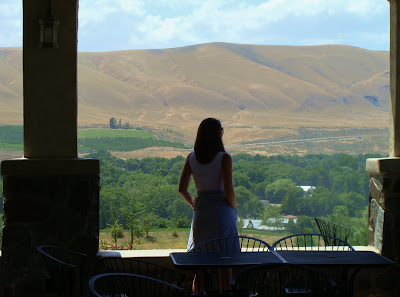
 and some stunning views.

That’s the back side of the Horse Heaven Hills in the background, across the valley from Red Mountain, where Terra Blanca is planted. This tiny little AVA (Washington’s smallest) produces some huge wines, as I’ve mentioned before. Terra Blanca’s wines have attracted a loyal following and many awards. The massive manse grabs a lot of attention, but the real story is in the vineyard. Owner and winemaker Keith Pilgrim has planted more than 60 different varieties or clones that aren’t found anywhere else in the state. He’s searching for the best his vineyard can produce. Terra Blanca bottles around 32,000 cases a year of distinctive Merlot, Cabernet Sauvignon, Syrah, Viognier, Sauvignon Blanc, Riesling and Chenin Blanc, as well as a premium blend called Onyx. The estate also yields Bordeaux varieties like Malbec, Petite Verdot and Cabernet Franc, along with a sampling of Sangiovese, Dolcetta and Barberra.

Pilgrim says the Cabernet is spectacular (this is Red Mountain, after all), but he’s also been pleasantly surprised by the intensity of the Marsanne, a grape that usually thrives in cooler climates.

In all Terra Blanca wines, look for what Pilgrim calls the Red Mountain signatures -- a chalkiness on the front of the palate before you taste the tannins on the roof of the mouth; a candied orange flavor, like Grand Marnier; and in Cabernet, a violet perfume opening up into the whole range of black fruits, moving very quickly into black cherry, blackberry and chocolate aromas.

Hungry yet? Wait, there’s more. Pilgrim says he has unearthed a lot of different flavors in various Syrah clones, from wild blueberry and huckleberry, to white pepper, and on to leather, tobacco and bacon fat.

Mmmmm. You had me at bacon fat. And chocolate. All at the same time.  Like this:

(This beautiful confection, created by the magicians at Tee & Cakes in  Boulder, Colorado, has nothing whatsoever to do with Terra Blanca wines, other than it captures in one very real mouthful the flavors Cabernet Sauvignon evokes.  Fun, yes?  But not available at Terra Blanca's tasting room.) 


Instead, you can enjoy complementary tastings of your choice of three wines, or choose a $5 flight (a white flight, Red Mountain reds, Winemaker’s choice, or a Dessert flight). The $5 fee is refundable with a purchase of wine.

Wednesday, July 20, 2011

My daily piece of chocolate


I knew a girl in college who found something special every day. Margaret didn’t stumble upon 4-leafed clovers, or diamond rings inadvertently dropped in the grass, or anything like that. Her special things weren’t particularly serendipitous. She made them. And I don’t mean arts-and-crafts, either.

She had a personal goal to do something, taste something, see something, each and every day, to make that day special. I don’t actually remember too many of her tricks (once she hiked over to the registrar’s office and demanded to see her “permanent file”) but the memory of her intent – her grand plan to make the world a special place – has always made me smile. I think it’s a wonderful way to approach life.

This, then, is my tribute to her special world: my daily piece of chocolate.

I started this little ritual about a year ago, when a friend sent a small box of Godiva chocolates to my office as a thank you for writing a letter of recommendation for his application to medical school. Unnecessary, but very sweet, I thought. Then I tucked the box into a drawer and tried to forget about it. Why, you ask? Why would anyone try to forget about Godiva chocolates? I dunno, I was probably trying to diet or some such craziness.

But I was not able to forget about it. Every morning as I unlocked the door to my office, my eyes darted to that little credenza across from my desk where I had stashed the goods. Every morning, I would quickly zip past the credenza and settle myself behind my desk. From here, I could not reach the chocolates. I could see their hiding place, of course, which became a special kind of torment, but I couldn’t reach them. In order to touch the chocolate, I would have to stand up, climb around my u-shaped desk, scramble over a pile of papers stacked on the floor, move some boxes off the chair next to the credenza that blocked the drawer, open the drawer, rearrange the files burying the pretty gold box, then pry off the ribbon keeping said box tightly sealed. (My office, as you might have guessed, is not conducive to quick moves.) Waaay too much trouble for a little piece of chocolate. That was my hope.

But then, I reconsidered. What was I trying to avoid, besides big(ger) hips? Gluttony? Decadence? Self-indulgence? What?

Burying that chocolate was symptomatic of a misguided approach to life. I was trying to eliminate indulgences that could make me soft and undisciplined. No playing when there is work to be done. No resting without a work-out first. No relaxing in the sun when there is a garden to be weeded. No dessert before the vegetables. I was trying to impose a kind of nose-to-the-grindstone, no-nonsense work ethic that would make me more productive, thinner, richer, prettier, stronger.

The problem was, I couldn’t stop thinking about that chocolate. Finally, after fighting the impulse for several weeks, I caved. I climbed across the mountain of barricades between me and Godiva, dug the box out of the drawer, reverently lifted the lid, and delicately selected a single confection. Then I reburied the box, made my way back to my desk, settled into the chair, closed my eyes, and ate the sweet dark caramely chocolate beauty.

It was a very good decision. It made my day special. And it reminded me of Margaret and her quest to make every day a special day. There’s not much nutritiously good or useful about chocolate, but civilizations have gone to war over it because it is so delicious. Not good for you, but good. Chocolate makes people smile. It makes them sigh with pleasure. It makes them happy. And isn’t that good for you?

I hope you find a small piece of chocolate in your life everyday.

Wednesday, July 13, 2011

Home for the holidays


Over the 4th of July holiday, we squeezed in a few of our favorite summer activities.
Wine tasting is one of them.


So is boating.
So is dancing.


Just like Michael Jackson.  Only better.

                                        
What is it about coming home that makes the kids think they’re rock stars? Long live Wii.

But back to wine tasting. We did a quick swing around Red Mountain, stopping off at a handful of the outstanding wineries there, including Kiona Vineyards.

Owner John Williams pioneered the area more than 30 years ago when he and his partner Jim Holmes, who now owns the famed Ciel du Cheval Vineyard across the road from Kiona, planted the first vines on what was a desolate, grass-covered mountain, before there was a road or even electricity there.

A lot has happened since then. Red Mountain is dotted with a growing collection of outstanding producers. The Williams family, including son and winemaker Scott Williams, now tend around 300 acres of grapes. They bottle some delicious Chardonnays, tasty Merlots and big, robust Cabernets, a wine that grows exceedingly well at their warm, sunny vineyard on the lower elevations of Red Mountain. They also bottle Syrah, Gewurtztraminer, Chenin Blanc and Reisling.

But don’t overlook the Lemberger. It’s a lighter, fruitier quaff than the big Cabernets or Merlots coming off Red Mountain, an easy-drinking wine often paired with patio food – grilled flatbreads, burgers, sausages, barbecue pork. Not a lot of wineries bottle Lemberger. Instead, they turn to softer blends of Cabernet, Merlot and often Syrah as their entry-level wine – the bottle priced to quickly move out the door. But when done well, Lemberger has all the character and intrigue so often missing from “everyday” bottles.

And Kiona’s Lemberger is notable. The Williams first planted it, according to John, to catch the eye of wine writers with something a little different. Not a bad plan.  It’s also caught the eye of quite a few wine judges  over the years.                                                                                                                                                                             What better place to sample it than from the patio at the Kiona tasting room, with sweeping views of the vineyards rolling across the slopes of Red Mountain. It’s a rock star.